

Already making more bags? How to expand your workshop with compound feed flatbed machines
When the workshop starts to get busy, a single cylinder bed machine becomes a bottleneck: everything goes through it, and every change of operation means changing feet, guides and settings. The logical next step is to split the work in two, flat work and shaped work, and give each one the right machine.
Flat work and shaped work
Almost every bag goes through two very different stages:
- Flat work: pieces sewn laid out on the table before assembly. Decorative topstitching on panels, flaps and covers, patch pockets, handles and shoulder straps, reinforcements, linings and joining flat pieces together.
- Shaped work: when the bag already has volume. Closing assembled pieces, gussets, curved seams, narrow areas and three-dimensional operations. Here the free-arm cylinder bed (PFAFF 335, Dürkopp Adler 269) is still in charge, as we explain in our advice for getting started.
Doing flat work on a cylinder bed machine is possible, but it isn’t ideal: the piece has nothing to rest on and it is harder to keep a seam straight and at a constant distance from the edge. That’s why having cylinder bed machines and compound feed flatbed machines in the same workshop is already a big step forward.
Two benchmark flatbed machines: PFAFF 1245 and Dürkopp Adler 267
For flat work we recommend two models with a strong track record in leather goods: the PFAFF 1245 and the Dürkopp Adler 267. Both are single-needle compound feed flatbed machines, designed for medium and heavy materials such as leather and technical fabrics.
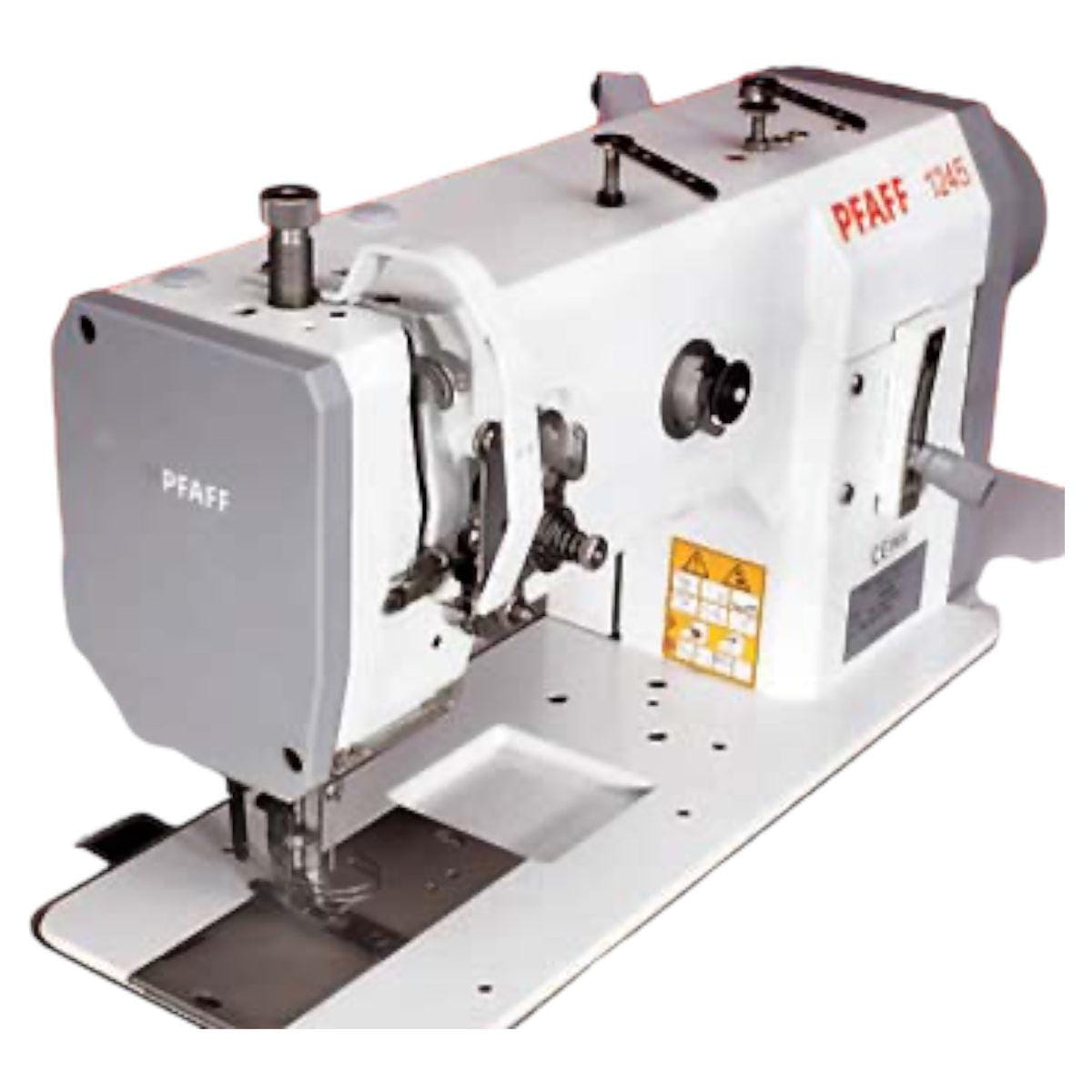

Why a flatbed machine is more accurate on flat work
- Support surface: the whole piece rests on the table and doesn’t hang. The seam comes out straight and at the same distance from the edge from start to finish.
- Compound feed: the material is moved at the same time by the feed dog, the needle and the alternating foot. On long lines of topstitching the layers don’t shift and the stitch stays even.
- Room to equip the machine: the plate and table leave space to fit guides, stops and fixed attachments that won’t fit or get in the way on a cylinder bed machine.
Equip each machine for its operation
That is the big advantage of taking the step. The more accurate machines can be fully equipped for a specific operation:
- Subclasses: the same base machine comes in different versions depending on the material and the job. If the volume justifies it, the automatic versions, with automatic thread trimmer, backtacking and presser foot lifter, save seconds on every seam and make the work more consistent.
- Edge guides: for decorative topstitching always at the same distance from the edge, piece after piece.
- Stops: to start and finish the seam at the same point on handles, pockets and reinforcements.
- Specific presser feet: for sewing very close to the edge, over steps in thickness or with decorative stitching.
The result: less set-up time, fewer mistakes and repeatable quality, which is exactly what you need when you produce in series.
What a workshop with more production looks like
- Cylinder bed workstation (PFAFF 335 or Dürkopp Adler 269): closing, assembling, binding and sewing curves and narrow areas.
- Flatbed workstation with guide (PFAFF 1245 or Dürkopp Adler 267): decorative topstitching and edge seams on panels, flaps and covers.
- Second flatbed workstation with stops, when production grows: handles, shoulder straps, pockets and reinforcements.
We keep the same configuration advice as for the cylinder bed workstation: a powerful industrial servo motor of at least 850 W, so you have power when sewing slowly through several layers. And if you work very thick leather, the limit is set by the thickness, not the series: in that case it is worth moving to a special-level machine even if the volume is small.
At a glance
When you’re producing more, separate flat work from shaped work. A PFAFF 1245 or a Dürkopp Adler 267 alongside your cylinder bed machine gives you accuracy on flat pieces, and each workstation, fitted with its subclass, guides and stops, stays ready for its operation.
Already working professionally? Read the next step: fully featured flatbed and cylinder bed machines.
When the flatbed and cylinder bed aren’t enough: special machines
Some operations on bags can’t be done well on either a flatbed or a cylinder bed: very tight corners, very small bags, gussets and side finishes right at the edge. That’s what special machines for leather goods are for, such as the Brother – Cometa series: the VCA 40 02 XXS post bed, the VBO XXS with swing arm, the VBG TR rotating arm and the VBS 01 for gusseted items.
CO.ME.TA. also builds its special machines on Dürkopp Adler and JUKI heads. In the Dürkopp Adler – Cometa series you have the VP 867 compound feed flatbed, the VBO swing arm, the VBG rotating arm, the VCA 40 Mod. 01, VCA 40 Mod. 02 and VCA 888 post beds and the VBS 669 narrow arm. In the Juki – Cometa series, the VCA 40 Mod. 02 XXS SD rotating XXS post bed, with compound feed.
Would you like to organise your workshop by workstations?
Tell us what you make, with what materials and how much you produce. We’ll help you decide which machines to add and how to equip them, with no obligation to buy.
2026 trend: luxury leather goods
Subcontracting for luxury brands is growing in Spain and Portugal, and their quality controls demand high-precision machines. We explain it in Trends 2026: Brother – Cometa for luxury leather goods.