
Guides · To start
What are the parts of an industrial sewing machine called?
Each part with its photo or drawing, what it is for and its other names.
Anyone starting out with an industrial machine comes across lots of technical words, and the same part can have several names. In this guide you have each part with its photo, what it is for and the other names you will hear.
We take as an example a single-needle lockstitch flatbed, the most common machine in workshops. Compound feed, post bed and cylinder bed machines have almost all these parts, arranged differently.
A complete machine: PFAFF 2083
Flatbed machine mounted with its stand, table top, thread stand, knee lifter and pedal. Click a number to go to its description. The parts inside the machine are further down, with the drawings from the PFAFF manual.
Index of parts
- 1Machine head
- 2Handwheel
- 3Thread stand
- 4Thread guides
- 5Thread tension and check spring
- 6Take-up lever
- 7Needle bar and needle
- 8Presser foot
- 9Needle plate
- 10Feed dog
- 11Hook
- 12Bobbin case
- 13Bobbin
- 14Stitch length regulator
- 15Reverse lever
- 16Oil sight glass
- 17Bobbin winder
- 18Table top
- 19Stand
- 20Motor
- 21Knee lifter
- 22Pedal
The machine head: what you see from above
1Machine head
Also called: head, machine body
This is the machine itself: the cast iron or aluminium body that houses all the mechanisms. It has the head on the left, where the needle works, the arm across the top, the column on the right and the bed, where the fabric rests. It sits recessed in the table top.
2Handwheel
Also called: pulley, hand wheel
The wheel on the right-hand side. It is connected to the main shaft and, by turning it by hand, you raise and lower the needle slowly. The direction depends on the machine: on lockstitch machines it is turned towards you, anticlockwise, and on overlockers, away from you, clockwise.
3Thread stand
Also called: cone stand, spool stand
The thread stand sits on the table top, behind the machine. It holds the thread cones, and at the top it has the guides through which the thread runs down to the machine. If the thread slips off the cone and catches on the plate, it breaks.
4Thread guides
Also called: thread guide, eyelets, guides
The eyelets and hooks the upper thread passes through from the thread stand to the needle. If the thread misses one, the stitch comes out badly or the thread breaks.
5Thread tension and check spring
Also called: tension, tensioner, tension discs; check spring: take-up spring, thread controller spring
The discs that grip the upper thread to give it tension. On machines with a thread trimmer there are two: a small pre-tension and the main tension. Next to the tension unit is the check spring, which takes up the slack thread while the stitch is being formed.
6Take-up lever
Also called: thread take-up lever, take-up
The lever that moves up and down in the head, above the needle. It sets each stitch: once the hook has taken the loop around the bobbin, the take-up lever rises and tightens the thread. Its motion, the kinematics, is very important and depends on the type and size of the hook, which is why each machine has its own. To start sewing it has to be at the very top, otherwise the thread pulls out of the needle.
7Needle bar and needle
Also called: needle bar, needle holder
The bar moves up and down and holds the needle with a screw. The needle carries the upper thread through the fabric. Each machine requires a specific needle system: on flatbed lockstitch machines it is usually DB×1 and on heavy-duty machines, 134 or DP×5.
8Presser foot
Also called: foot, presser
The foot that presses the material against the feed dog. It is essential for forming the stitch and for moving the material forward. There are many shapes, each one designed for a job: the one in the photo, for example, is a zipper foot. It is raised with the lever on the head, with the knee lifter or, on electronic machines, with the pedal. The pressure is adjusted with the screw on top of the head or, on some machines such as the Dürkopp Adler 281, with the large wheel on the arm.
14Stitch length regulator
Also called: stitch dial, stitch length regulator
The numbered wheel on the arm or column. It sets the stitch length in millimetres. On electronic machines it is set on the panel.
15Reverse lever
Also called: backtack lever, reverse; backtack or reverse button
The lever next to the regulator. While you hold it down, the machine sews backwards to backtack. Many machines also have a backtack button on the head, next to the needle, so you can backtack without letting go of the fabric. Electronic machines also backtack automatically at the start and end of the seam.
16Oil sight glass
Also called: oil window
The small window on machines with automatic lubrication. With the machine running, you should see oil splashing. If it doesn’t splash, lubrication is failing and you have to stop. The oil level is checked in the sump, under the machine.
17Bobbin winder
Also called: winder
The bobbin winder mounted on the machine itself, usually on the arm. It fills the bobbin with thread while you sew: you put the bobbin on the spindle, pass the thread and it stops by itself when full. On other machines the winder is separate, screwed to the table top.
Under the plate: where the stitch is formed

9Needle plate
Also called: throat plate
The flat plate under the presser foot. It has the hole the needle goes down through and the slots the feed dog comes up through. Underneath are the hook, the bobbin case and the bobbin.
10Feed dog
Also called: feed, feeder
The teeth that come up through the plate and move the fabric on each stitch. On compound feed machines the fabric is moved at the same time by the feed dog, the needle and a walking foot.
11Hook
Also called: rotary hook, shuttle
It is the heart of the machine and the part that forms the lockstitch. It rotates under the needle plate: its point catches the loop of upper thread and takes it around the bobbin. It has to be timed with the needle to the millimetre.
12Bobbin case
Official name: bobbin case
Also called: bobbin holder, bobbin box
The case that holds the bobbin, fitted inside the hook. It has a spring with a small screw that sets the tension of the lower thread. It is the part people ask about as “the bit where the bobbin goes”.
13Bobbin
Official name: bobbin
Also called: spool
The small reel that holds the lower thread. It is filled on the winder and goes inside the bobbin case.
Table top, stand and motor
18Table top
The board in which the machine is recessed. It has a cut-out made to fit the head and, on top, the thread stand.
19Stand
Also called: frame, table stand
The metal frame with legs that supports the table top. It carries the pedal and, in many cases, the motor hanging under the table top.
20Motor
Also called: servo motor
Today almost all are servo motors: they are silent, only turn when you press the pedal and can stop with the needle up. Electronic machines have the motor inside the head and a control box under the table top.
21Knee lifter
Official name: knee lift
The lever under the table top that you push with your knee. It raises the presser foot without you having to let go of the fabric.
22Pedal
Also called: start pedal, treadle
You sew by pressing with the toe, and the harder you press, the faster the machine goes. On machines with a thread trimmer, pressing back with the heel raises the presser foot or trims the thread.
Common accessories

Edge guide
Official name: edge guide
Types: fixed edge guide and overhead (swing-away) edge guide
It acts as a stop for the edge of the fabric, so the seam is always the same distance from the edge. There are two types: the fixed one, screwed to the machine bed, and the overhead one, which sits above the material and swings away when not needed.
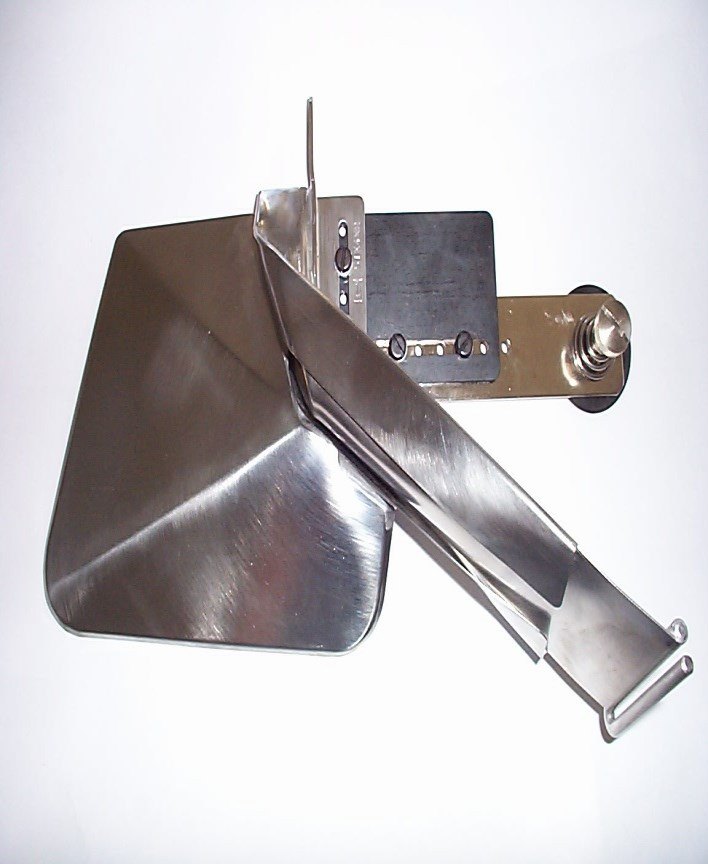
Binder and folder
Also called: funnel, folder, bias binder
A funnel that folds the tape or fabric before it reaches the needle. It is used for binding or hemming in a single pass.
Finger guard
Official name: finger guard
Types: wire finger guard and sheet metal finger guard
It sits in front of the needle and presser foot so that a finger can’t get under the needle. The one in the photo is a wire finger guard. Many machines also have a transparent shield to protect the eyes if a needle breaks. They are safety parts and must not be removed.
Frequently asked questions
What are the main parts of an industrial sewing machine?
The head, which is the machine itself; the table top, in which it is recessed; the stand, which supports it; and the motor with the pedal. On the head are the needle, the presser foot, the take-up lever, the tension unit and, under the needle plate, the hook, the bobbin case and the bobbin.
What is the part where the bobbin goes called?
The bobbin goes inside the bobbin case, and the bobbin case fits into the hook, under the needle plate.
Are a hook and a shuttle the same thing?
Yes. On today’s industrial machines, hook, rotary hook and shuttle refer to the same part. Old shuttles were a different part that moved back and forth, but today the word is also used for the rotary hook.
What is the take-up lever for?
It sets each stitch. Once the hook has taken the loop around the bobbin, the take-up lever rises and tightens the upper thread. Its motion depends on the type and size of the hook. If you start with the take-up lever down, the thread pulls out of the needle.
Do one brand’s parts fit another?
Generally not. Hook, bobbin case, bobbin, plate and feed dog vary by brand and model. Some manufacturers, such as Cerliani, make hooks and parts for many different machines. If you tell us the brand and model, we will tell you which part it takes.
Other guides
- What are the parts of an industrial overlocker called?
- What are the parts of an industrial coverstitch machine called?
- Why does the upper thread break?
- Why does a machine skip stitches and how do you fix it?
- Industrial needle guide
- All troubleshooting guides
Looking for a part and don’t know what it’s called? Send us a photo on WhatsApp with the brand and model of the machine and we will tell you which it is.
Spare parts Contact Maquinorya