
Automotive machinery: cutting, sewing and sealing of interiors
Seats, side panels, door panels and dashboards in leather, leatherette and slush skin. Compound feed to sew over foam, single-ply cutting and seam sealing so that foam and adhesive don’t show on the visible side.
Vehicle interiors have a problem that garment manufacturing doesn’t: thick materials, thick thread and visible stitching. What comes out of the machine stays on view inside the car for fifteen years, and any feed, stitch or finishing defect shows. A conventional flatbed isn’t up to it.
Three applications in automotive
A seat isn’t sewn the same way as a dashboard or a seat belt. Go to yours:
What is made and with which materials
Seats and backrests, side and door panels, dashboards, soft tops, covers and replacement upholstery. The usual materials are leather, leatherette, slush skin, Alcantara, laminated foam and technical fabrics, almost always in several layers and several millimetres thick.
Three operations, three machines
A vehicle interior goes through cutting, sewing and, for most pieces, seam sealing. They are three different technologies and it is worth understanding what each one does before looking at prices.
Sewing: why compound feed and nothing else
It is the question we are asked most and the answer is mechanical. When you sew leather over laminated foam, the two layers don’t have the same hardness. A machine with bottom feed only moves the lower layer and leaves the upper one behind: the piece goes out of line, puckering appears and the visible seam comes out crooked. Compound feed (feed dog, needle and presser foot moving together) pulls the layers along together and keeps them parallel to the end of the seam.
Add to that the long stitch length and presser foot lift these materials need, and the ability to work with thick thread without skipping stitches.
Which machine for your production
| Your situation | Machines |
|---|---|
| Upholstery and customisation workshop. Varied pieces, short runs, lots of job changes. | PFAFF 1245 · JUKI LU-2810 |
| Medium production. Repetitive pieces, full working day, several units a day. | Dürkopp Adler 867 Basic · 867 Eco · 267-373 |
| Series and decorative stitching. Parallel double stitching, OEM finish. | Dürkopp Adler 867 Classic · JUKI LU-2860 (2 needles) · Gamma 767 |
This is guidance, not a recipe. The real choice depends on the exact thickness, the thread and how many pieces you need a day: tell us and we will pin it down.
Vetron and Typical compound feed
As well as the machines in the table above, we work with two more compound feed families that are very common for automotive parts: the Vetron post bed machines, for covers, seat sides and headrests, and the Typical flatbeds, for joining and topstitching leather and faux leather in short runs.
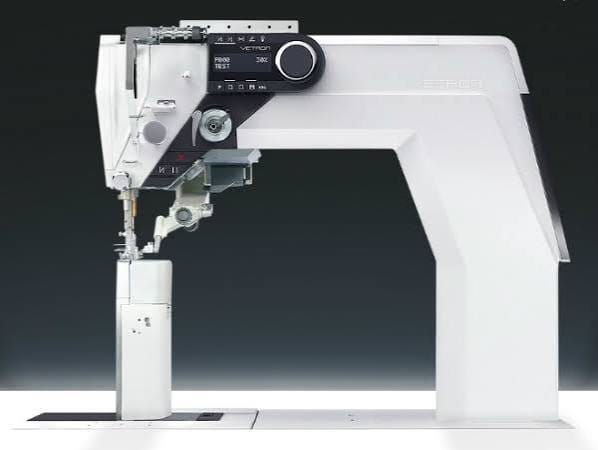
Vetron 5300
Compound feed post bed, 1 needle, direct drive. Post on the right: clean access to bulky pieces.
See data sheet →
Vetron 5320
The same post bed in a 2-needle version: parallel double topstitching for the decorative finish.
See data sheet →
Typical GC20665
Compound feed flatbed, 1 needle, 750 W direct motor. Medium and heavy material. The GC20666 is the 2-needle version.
See data sheet →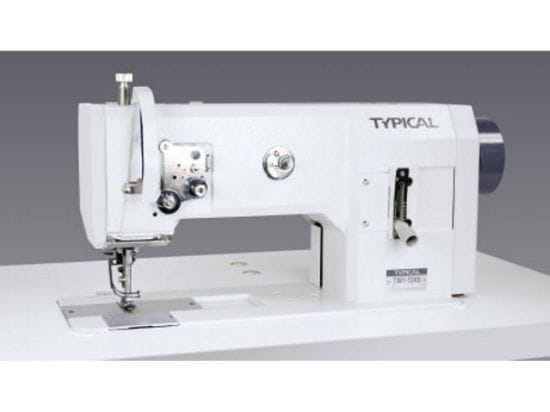
Typical TW1-1245
Single-needle flatbed with true compound feed: feed dog, needle and alternating presser foot. A machine for daily work.
See data sheet →The post bed is what changes the work on a seat: with the piece already assembled, a flatbed forces it while a post bed lets it hang. The Typical machines cover flat sewing, before assembly.
Cutting: why single-ply
Leather doesn’t stack. Every hide has its own shape, defects and usable area, so automotive cutting is single-ply with piece-by-piece optimisation, not multi-ply as in garment manufacturing. That is what the KURIS Cutty single-ply CNC cutting table is for.
Seam sealing: what it is really for in a car
There is a common misunderstanding here. In outdoor clothing, seams are sealed to keep water out. In automotive, they are sealed for another reason: to cover the seam on the inside and stop the foam or the adhesive coming through the needle holes to the visible side of the piece.
Every stitch is a perforation. When there is laminated foam and adhesive behind it, and the piece is shaped with heat and pressure, that material looks for a way out and finds it along the seam line. The result shows on the finished seat, which is where it costs most.
It is applied to seats, side and door panels and dashboards, on leather, leatherette and slush skin. The machines for this are the PFAFF 8303i-340/001 Baseline and the 8303ix-340/011 with front post and the 243/011 with rear post, depending on how the piece has to be accessed.
If you want to see all the operations of a seat cover in order, with the machine for each one, we explain it in the guide How is car upholstery made?
Frequently asked questions
Will a double feed flatbed do instead of compound feed? For thin leather and a single layer it may get by. As soon as you put foam behind it or several layers of different hardness, double feed falls short and the layers start to shift.
How many needles do I need? One needle for joining seams. Two needles when parallel decorative topstitching is part of the design of the piece, which in automotive is almost always.
Is sealing needed on every piece? No. It is needed where there is foam or adhesive behind the seam and the visible side is exposed. On a cover without a shaped backing, usually not.
Can you help me choose without visiting you? Yes. Tell us what material you work with, the thickness, whether there is foam behind it and how many pieces you need a day. With that we will suggest a machine and show you videos of it working that material.
Tell us about your piece
We analyse the material, the thickness and your production before recommending anything. Request technical advice.
Do you have a specific seat, panel or interior piece? Send us your case with photos of the material and the seam, and we will tell you which machine fits.