
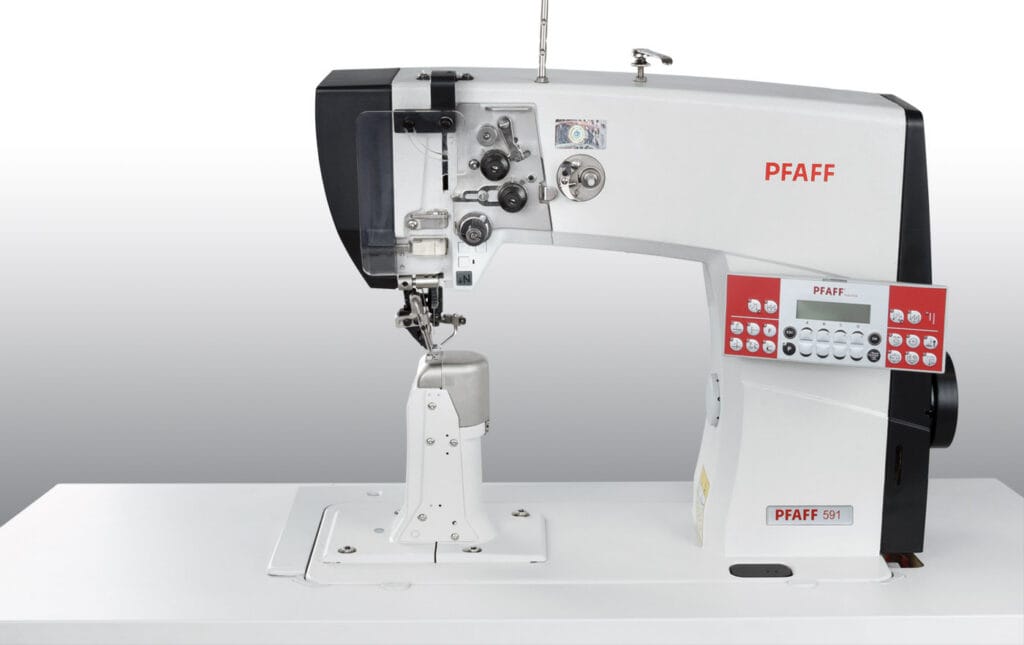
Which sewing machine do you need to make footwear?
To sew footwear you need a post bed machine and, if your models have bound edges, a cylinder bed as well. The flatbed has little work in footwear: the shoe upper takes shape very early and from then on it no longer lies on the table.
Here we are talking about closing, that is, sewing the upper: vamp, quarter, lining and reinforcements. Lasting and sole attaching are different operations and need different machinery.
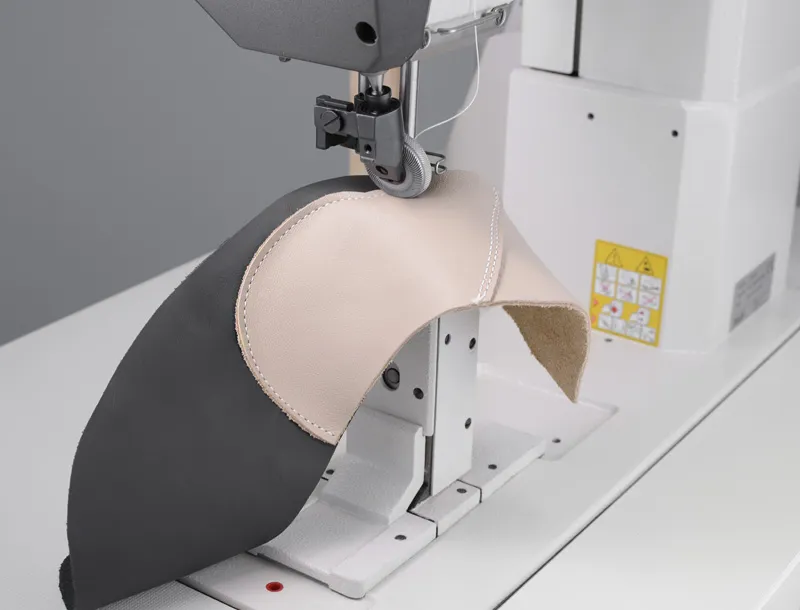
What is sewn when closing a shoe
Closing joins the parts of the upper: the vamp, the quarters, the heel counter, the tongue and the reinforcements. Some seams are joining seams and others are visible topstitching, with one or two needles, which on a shoe can be seen from a distance. On boots you also have to close the shaft and sew in the zip.
Then there is the lining. It is sewn to the upper and the excess is trimmed off close to the seam. On a machine with a trimmer both things are done in the same pass.
Why footwear is sewn on a post bed
On a post bed machine the sewing point is at the top, on a post just a few centimetres wide. The piece goes around the post and you can turn it as you sew, which is exactly what the toe or heel of a shoe needs. On a flatbed that piece would have to lie flat, and a shaped upper no longer lies flat.
The other very important detail on a footwear machine is the type of feed. Footwear post bed machines usually feed with a wheel foot: two wheels, one above and one below, that grip the leather between them and move it forward.
With this feed the leather is held at only one very small point, and that makes it very easy to move the piece while you sew. You notice it most on curves and very tight shapes, where with a normal presser foot and feed dog the piece does not turn as freely.
Wheel feed often comes with needle feed as well: the needle goes into the leather and moves forward with it, so the layers do not shift against each other.
The width of the post is the first thing to decide, before the brand. A narrow post gets into curves and corners a wide one cannot reach, and a wide one supports large pieces better. Choose the one that fits your tightest piece, not your most usual one.
The classic post bed machines: 571, 591 and 574
In footwear there are three numbers everyone knows. We have them in PFAFF and in Typical:
- 571, 1-needle post bed with the post to the left of the needle: PFAFF 571-1i and Typical TW1-571.
- 591, 1-needle post bed with the post to the right: PFAFF 591-1 and Typical TW1-591.
- 574, 2-needle post bed for double topstitching: PFAFF 574-2 and Typical TW2-574.
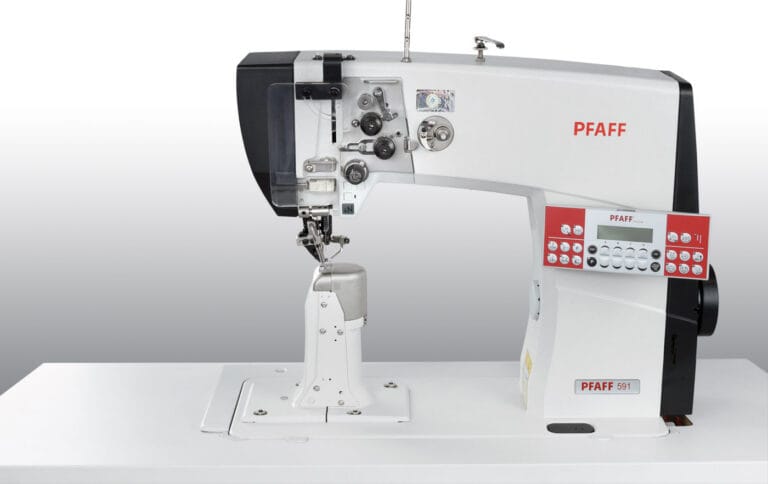
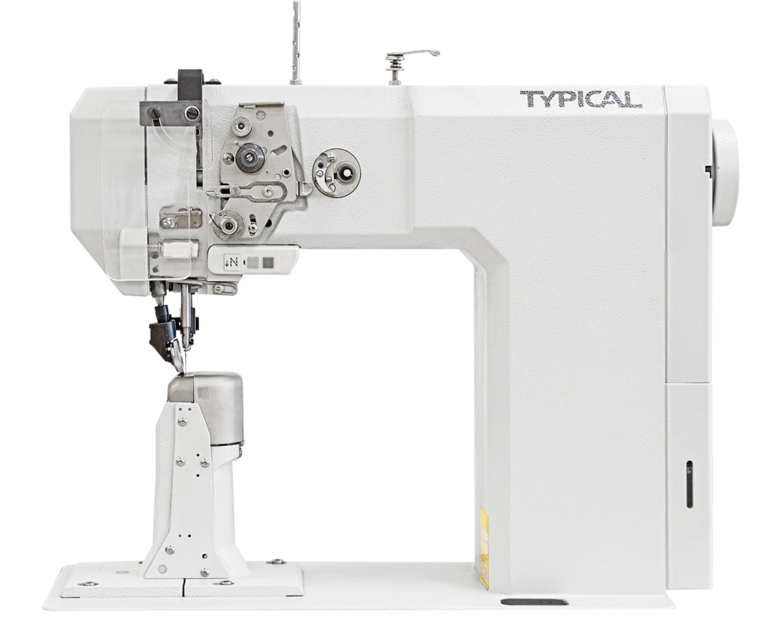
Whether the post is on one side of the needle or the other changes where the rest of the shoe falls while you sew. Depending on the model and the seam one is more comfortable than the other, which is why many workshops have both.
Post bed machines with a trimmer are a separate case and count as special machines: they have a knife that trims the inner lining close to the seam while sewing. In PFAFF these are the 571 and 591 in subclass 725 and the electronic 1571, 1574 and 1591 with trimmer; in Dürkopp Adler, the 888-356020 and 888-356122. They are used mainly on high-quality footwear, where the lining has to be trimmed clean and flush.
The Typical TW1-591 comes in an M version and an H version; the H reaches a 7 mm stitch, for boots and topstitching with thick thread.
To start: a post bed, and an arm machine if you bind edges
If you are setting up your first closing station, start with two machines:
- A 1-needle post bed, PFAFF 591-1 or Typical TW1-591, for joining pieces, topstitching and lining.
- A cylinder bed machine, such as the PFAFF 335G, if your models have bound edges. In footwear, arm machines are used mainly for binding the edge: the piece goes onto the arm and turns around it while the binding wraps the edge.
Most of the closing on a shoe or boot is done on the post bed. For binding on tighter curves, the Dürkopp Adler 669 has a reduced-diameter arm and compound feed.

As with any industrial station, each head goes with its stand, its table top and an industrial servo motor. A post bed head on a domestic table only gives you vibration and poor control.
When you produce more: one station for each seam
With more pairs a day, changing presser foot, needle or thread every time you change seam eats into your time. The usual thing then is to leave each machine set up for one operation.
| Operation | Machine |
|---|---|
| Joining pieces and simple topstitching | 591 post bed: PFAFF 591-1 or Typical TW1-591 |
| Decorative double topstitching | 574 2-needle post bed: PFAFF 574-2 or Typical TW2-574 |
| Seams where the shoe has to sit on the other side | 571 post bed: PFAFF 571-1i or Typical TW1-571 |
| Trimming the inner lining on high-quality footwear | Post bed with trimmer: PFAFF 571 or 591 in subclass 725, PFAFF 1571, 1574 or 1591 with trimmer, or Dürkopp Adler 888-356020 and 888-356122 |
| Binding edges | Cylinder bed: PFAFF 335G or Dürkopp Adler 669 |
| Binding edges on thick leather | Dürkopp Adler 69-373H, cylinder bed for heavy material |
| Sealing seams on waterproof footwear | PFAFF 8303ix-243/011 or PFAFF 8330-243 |
That way each station keeps its own needle, thread and presser foot, and the seam comes out the same whoever sews it.
Series production: electronic post bed machines and pattern sewing
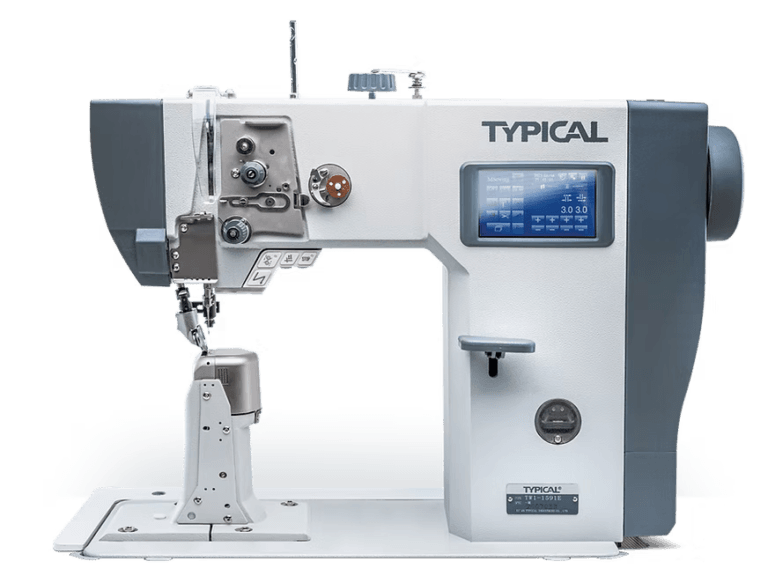
In series production the seconds on each seam count. The electronic post bed machines PFAFF 1571-1, PFAFF 1574-2, PFAFF 1591-1 and Typical TW1-1591E have a motor with control panel and, depending on the subclass, automatic thread trimmer, backtack and presser foot lift. On the PFAFF 1591-1 the stitch length is programmed from the panel. The Typical TW1-1591E has a 5″ touch screen and motorised wheel and roller, which pull the leather well on curves.
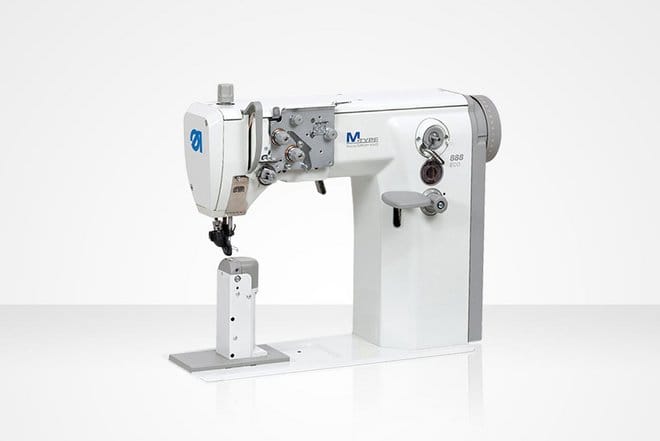
Dürkopp Adler has its own post bed series, the 888. The Dürkopp Adler 888-1 is 1-needle and the 888-2 2-needle. Both have a toothed feed wheel, needle feed and a motorised roller presser, built-in Direct Drive motor and automatic thread trimmer and backtack. They sew up to 3,000 stitches per minute, with stitch length up to 7 mm.
The Dürkopp Delta 888-1 is the version with a programmable touch panel, from the M-TYPE DELTA e-con platform. It reaches 2,500 stitches per minute and the stitch length is programmed from the panel, so each seam on the shoe can have its own program.
We explain why an electronic post bed sews footwear better, especially on backtacks, in electronic or conventional post bed for footwear.
For seams that are repeated the same on every pair (reinforcements, decoration, backtacks) there are pattern sewers: the Brother Nexio BAS-360H and its sisters up to the BAS-375H, the Juki PLK-J and the Dürkopp Adler 910 and 911 CNC units. The seam is set by the pattern and comes out the same on every pair, regardless of the operator’s hand.
Technical and waterproof footwear: sealing the seam
On a waterproof boot every stitch is a hole, so technical footwear has the seam sealed on the inside with tape. To seal inside the shoe you need a machine that goes in from behind. The PFAFF 8303ix-243/011 has a rear post for exactly that, and the PFAFF 8330-243 seals footwear seams with the same access.
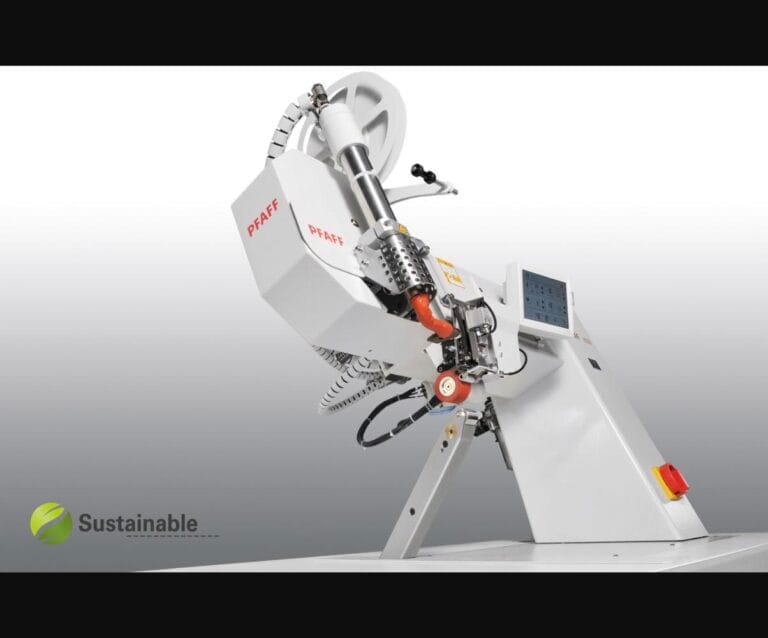
If you don’t sell waterproof footwear, you don’t need it. We explain how seam sealing works in what heat sealing is and when you need it.
Needle, thread and stitch according to the leather
Leather is sewn with a cutting point needle, which cuts the leather as it goes in. The point type and needle size change with the leather and the number of layers. Visible topstitching usually takes thicker thread and a longer stitch than the joining seam, and the lining a finer stitch.
Tell us which leather you sew and what finish you are after, and we will tell you which needle, thread and stitch length to use.
Frequently asked questions
Can you close shoe uppers on a flatbed machine?
Flat pieces, yes: linings, reinforcements or topstitching on a piece that has no shape yet. As soon as the upper takes on volume you need a post bed. That is why in a footwear workshop the flatbed, if there is one, is a support machine.
What is the difference between the 571 and the 591?
Both are 1-needle post bed machines. On the 571 the post is to the left of the needle and on the 591 to the right, and that changes where the rest of the shoe sits as you sew.
What is the 574 for?
It is the 2-needle post bed. It sews two parallel lines of topstitching at once, always the same distance apart, for decoration and double seams.
Mechanical or electronic?
To start out or for short runs, a mechanical post bed (571, 591 or 574) sews just as well. The electronic one (PFAFF 1571, 1574 or 1591, or the Dürkopp Adler 888 series) pays for itself with volume, because the automatic thread trimmer and backtack save seconds on every seam.
What footwear do you make?
Tell us which models you make, which leather you use and how many pairs you turn out a day. We will help you choose the machines and equip each station, with no obligation to buy.
Talk to our specialists · All the machines for the sector in footwear machinery.