

Why is footwear made better on an electronic post bed?
An electronic post bed, such as the PFAFF 1591, the Typical TW1-1591E or the Dürkopp Adler Delta 888, sews footwear more accurately than a conventional post bed. The difference comes down to two things: the length of each stitch is controlled by the electronics, and backtacks are always made with the same number of stitches and through the same holes.
On a shoe the seams are visible and short, with lots of starts and finishes. That is why these two things show so much on footwear.

What changes between a conventional and an electronic post bed
Both are footwear post bed machines with wheel feed and both can have a thread trimmer. What changes is who is in charge of the stitch.
| Conventional post bed | Electronic post bed | |
|---|---|---|
| Stitch length | Set by hand with the dial or lever | Programmed on the panel and held by the machine |
| Backtack | Done by the reverse mechanism; the backward stitch may not be the same length as the forward one | Fixed number of stitches, and the backward stitch returns through the same holes |
| Changing stitch within a seam | You have to stop and adjust the regulator | Each section of the seam can have its own stitch length |
| Repeatability between pairs | Depends on the operator’s hand and skill | The seam comes out the same on every pair |
Stitch accuracy
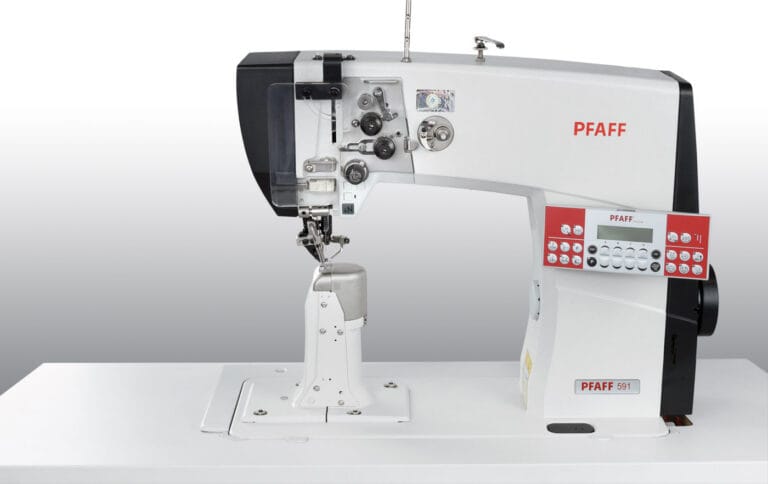
On a conventional post bed, such as the PFAFF 591-1, the stitch length is set by hand and depends on the mechanical adjustment. It works well, but the stitch can vary slightly with the thickness of the leather or when crossing a step in the layers.
On an electronic post bed the stitch length is programmed on the panel. On the PFAFF 1591-1 it goes from 0 to 7 mm and is set from the control panel, as on the Dürkopp Adler Delta 888-1. The machine holds that stitch along the whole seam, and on visible topstitching that is what makes the seam look even from toe to heel.

Backtacks: where it shows most
Every seam on a shoe starts and ends with a backtack, and an upper has lots of short seams. A badly made backtack shows straight away: stitches that don’t line up, doubled thread off the line or a knot that comes undone with wear.
On a conventional post bed the backtack is made by the reverse mechanism. Even if the machine has automatic backtack, the backward stitch is not always the same length as the forward one, and the thread does not go back through exactly the same holes.
On an electronic post bed the backtack is programmed: how many stitches back, how many forward and how long. Because the electronics control the feed in both directions, the return stitch falls into the same holes. The backtack is clean and tight, and comes out the same on the first pair as on the last.
Better adaptation to each section of the shoe
A footwear seam is not the same from start to finish. At the toe and heel there are tight curves, in other sections there are steps in the layers, and near the backtack a shorter stitch is sometimes better.
With an electronic post bed the seam is programmed in sections, and each section has its own stitch length. On the Delta 888-1 each seam on the shoe can have its own program. The operator concentrates on guiding the piece and the machine makes the changes.
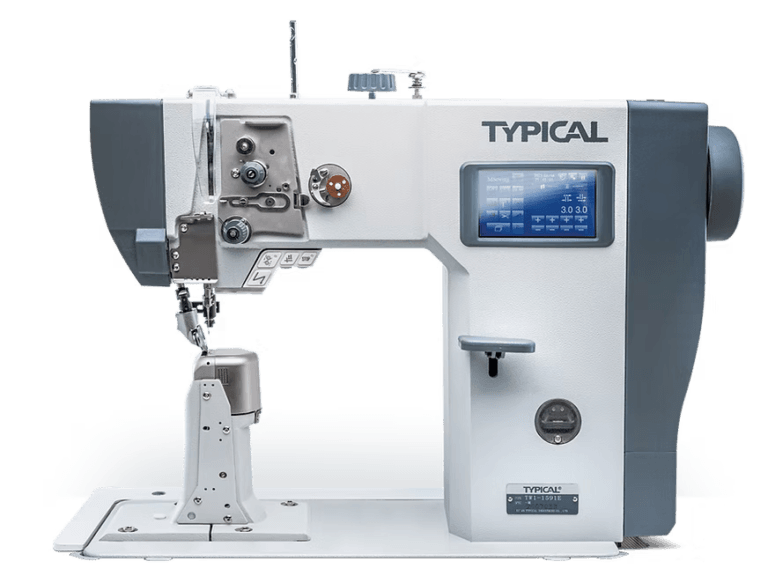
Then there is the feed. The Typical TW1-1591E has a motorised wheel and roller presser and a 5″ touch screen, and the Dürkopp Adler 888-1 and 888-2 have a motorised roller and Direct Drive motor. The roller works with the wheel and the leather moves forward the same on straights and curves.
Electronic post bed machines for footwear
- PFAFF 1571-1: 1-needle left-hand post, stitch from 0 to 7 mm programmed on the panel.
- PFAFF 1591-1: 1-needle right-hand post, stitch from 0 to 7 mm programmed on the panel.
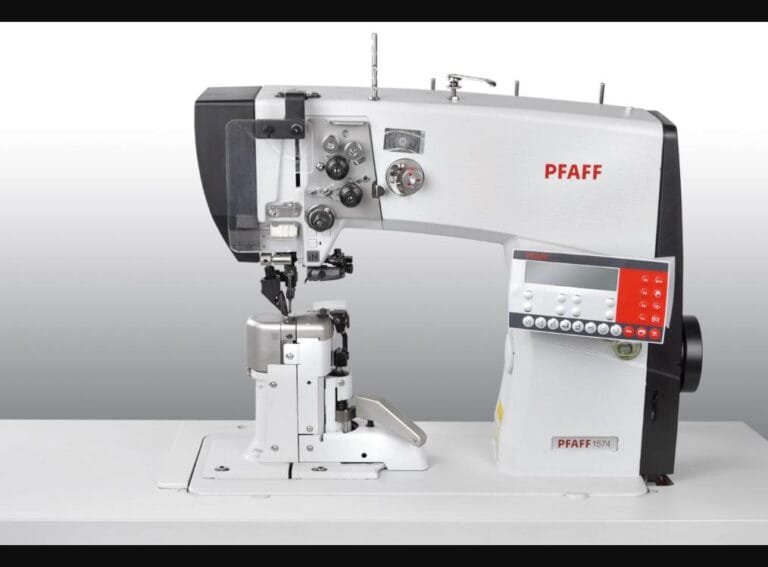
- PFAFF 1574-2: 2-needle post bed for double topstitching, stitch from 0 to 5 mm.
- Typical TW1-1591E: 1 needle, motorised wheel and roller, 5″ touch screen.
- Dürkopp Adler 888-1 and 888-2: 1 and 2 needles, motorised roller, up to 3,000 stitches per minute.
- Dürkopp Adler Delta 888-1: programmable touch panel, one program for each seam.
The PFAFF 1571, 1574 and 1591 and the Dürkopp Adler 888-356020 and 888-356122 can be ordered with a trimmer, to trim the inner lining on high-quality footwear.
When is electronic worth it?
It is worth it when the topstitching is visible, when you make quality footwear and when you produce in series, because every pair has to come out the same. It also helps with new staff: the machine stores the stitch and the backtacks, and the operator learns faster.
A conventional post bed is still a good buy for hidden seams, for short runs or for a workshop that is just starting. We explain it in which sewing machine you need to make footwear.
Frequently asked questions
Doesn’t a conventional post bed with automatic backtack do the same?
It backtacks, but with the usual reverse mechanism. The electronics control the length of each stitch, backwards too, and that is why the backtack goes back through the same holes and stays clean.
Can you change the stitch length in the middle of a seam?
On an electronic post bed, yes: the seam is programmed in sections and each section has its own stitch length. On a conventional one you have to stop and move the regulator by hand.
Is it worth it in a small workshop?
If you do visible topstitching or quality footwear, yes, because the backtacks and the stitch show on the finished shoe. For hidden seams and short runs, a conventional post bed still does the job.
Which electronic post bed machines do you have for footwear?
PFAFF 1571-1, 1574-2 and 1591-1, Typical TW1-1591E and Dürkopp Adler 888-1, 888-2 and Delta 888-1. Which one suits you depends on the seam, the material and whether you need a trimmer for the lining.
Want to see it with your leather?
Tell us which models you make, which leather you use and which seams give you trouble, especially at the backtacks. We will tell you which post bed suits you, with no obligation to buy.
Talk to our specialists · All the machines for the sector in footwear machinery.